Topical vs Oral Finasteride: Benefits, Differences & How to Choose
Finasteride, whether taken as an oral tablet or applied as a topical solution or gel, is one of the most commonly used medical treatments for androgenetic alopecia. Regardless of its formulation, its primary goal is to address the same underlying cause of hair loss. Their differences, concerning the mode of action and the potential side effects, are those who determine the most suitable form for each individual.
How Does Finasteride Work for Hair Loss?
Finasteride works by blocking the enzyme 5-alpha reductase, which converts testosterone into dihydrotestosterone (DHT), the hormone primarily responsible for androgenetic alopecia. In contrast to a common misconception, hair loss is not caused by testosterone itself, but by its conversion into DHT.
In individuals with a genetic predisposition, DHT binds to hair follicles and gradually causes them to shrink, a process known as follicular miniaturization. Over time, the affected hairs become thinner, shorter, and weaker, eventually leading to progressive hair thinning and loss.
By reducing DHT levels, finasteride helps protect hair follicles from further miniaturization, allowing more follicles to remain in the active growth (anagen) phase. This can slow the progression of hair loss, preserve existing hair, and, in some cases, promote noticeable regrowth.
Oral Finasteride: Effectiveness and Clinical Evidence
Oral 1 mg finasteride was approved by the FDA for the treatment of male androgenetic alopecia in the late 1990s and remains one of the most extensively studied medical therapies for hair loss. Taken once daily, it works systemically by reducing DHT levels throughout the body.
Clinical studies submitted for FDA approval demonstrated that oral finasteride was effective in approximately 88% of men aged 18–41 with mild to moderate androgenetic alopecia. Initial results are typically observed after 3 to 6 months of consistent use, while maximum clinical benefit is generally assessed after around two years of continuous treatment.
Its effectiveness is higher in the early stages of hair loss, when a significant number of hair follicles remain active. In cases of advanced thinning, oral finasteride cannot replace a hair transplant. However, it is frequently used before or after hair transplantation to help stabilize ongoing hair loss and preserve the existing, non-transplanted hair, supporting longer-lasting overall results.
Topical Finasteride: The Alternative Approach
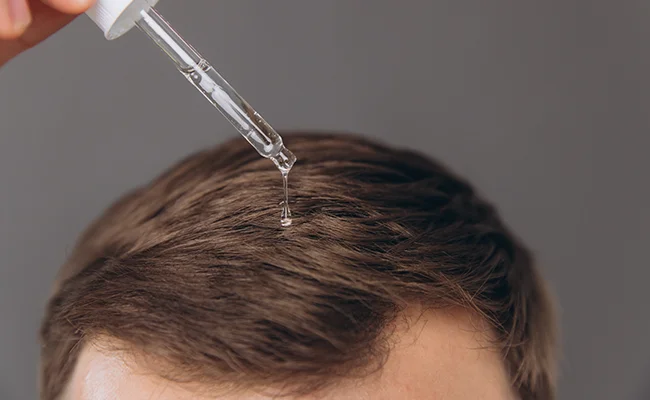
Topical finasteride is applied directly to the scalp as a solution or gel. Although it contains the same active ingredient as the oral tablet, the method of delivery is different. Unlike oral finasteride, topical formulations have not yet received FDA approval for the treatment of androgenetic alopecia. However, early clinical studies have shown promising results, with efficacy approaching that of oral finasteride, although long-term clinical data remain limited.
Applied directly to the scalp, topical finasteride inhibits the activity of the 5-alpha reductase enzyme within the treated area, reducing local DHT production around the hair follicles. Because its effects are primarily localized, it generally produces less systemic DHT suppression than oral finasteride, while still helping to decrease hair follicle miniaturization and support hair growth.
Since only a small amount of the medication is absorbed into the bloodstream, topical finasteride offers:
- Lower systemic exposure to the drug
- A potentially lower risk of systemic side effects
The concentration of topical finasteride can be adjusted according to individual treatment needs, with 0.25% being one of the most commonly prescribed formulations.
Side Effects: What Does the Evidence Show?
The greatest concern surrounding finasteride involves its potential sexual side effects, and these should be considered in the context of the available clinical evidence. According to the FDA-approved prescribing information for 1 mg oral finasteride, the most commonly reported sexual side effects include decreased libido, erectile dysfunction and reduced ejaculation volume.
In 12-month clinical trials, more participants discontinued treatment because of adverse events in the placebo group than in the finasteride group, highlighting that the overall difference between the two groups was relatively small.
Topical finasteride is believed to carry a lower risk of systemic side effects because its action is mostly confined to the scalp, resulting in lower systemic absorption. However, it may cause localized reactions at the application site, including itching, burning, redness, or irritation, particularly with higher-concentration formulations.
Although early studies suggest that topical finasteride may be associated with fewer sexual side effects than the oral formulation, long-term safety data remain limited, and significantly less evidence is available compared with oral finasteride.
Regardless of the formulation, finasteride is contraindicated during pregnancy and should not be handled by women who are or may become pregnant, as exposure may affect the normal development of the fetus. It is also contraindicated in individuals with known hypersensitivity to any of its ingredients and is not recommended for use in children or adolescents, as its safety and efficacy have not been adequately established in these age groups.
Choosing Between Oral and Topical Finasteride
There is no single form of finasteride that is suitable for everyone. The most appropriate choice depends on each individual’s medical history, pattern of hair loss, treatment goals, and personal preferences. Oral finasteride is generally considered the first-line option, as it has the strongest clinical evidence, is FDA-approved for the treatment of male androgenetic alopecia, and is available in a standard dosage.
Oral therapy is most commonly recommended when the primary goal is to achieve the greatest possible suppression of androgenetic alopecia progression. Topical finasteride, on the other hand, may be a suitable alternative for individuals who prefer lower systemic exposure, are concerned about potential systemic side effects or do not wish to take oral medication.
Ultimately, the decision should be made after a medical evaluation, taking into account the individual’s clinical profile and the expected benefits and risks of each treatment approach.
Looking for an Effective Hair Loss Solution?
Understanding the cause of your hair loss is the first step toward choosing the most appropriate treatment. Contact our clinics to schedule a personalized consultation and receive an individualized diagnosis and treatment plan.