


The earlier the treatment is started, the greater the chances of slowing progression and preserving existing hair. Timely intervention is crucial.
Androgenetic Alopecia: Causes, Symptoms & Treatment of Hereditary Hair Loss
Androgenetic alopecia is an evolutionary form of hair loss related to heredity and the sensitivity of hair follicles to androgens.
It appears as gradual thinning in specific areas of the scalp and affects men and women to different degrees.
What is Androgenetic Alopecia
Androgenetic alopecia (also known as “hereditary” hair loss) is the most common form of alopecia. It has a progressive course and a clearly defined genetic background.
It is caused by increased sensitivity of hair follicles to dihydrotestosterone (DHT), a derivative of testosterone, which gradually leads to the shrinkage of hair follicles and a reduction in the hair growth phase.
Hair loss follows characteristic patterns in men and women, and its onset can occur as early as adolescence.
The severity and progression vary depending on genetic predisposition, androgen levels, and other aggravating factors.
If started early, appropriate treatments allow management of alopecia to the extent possible in each individual case.
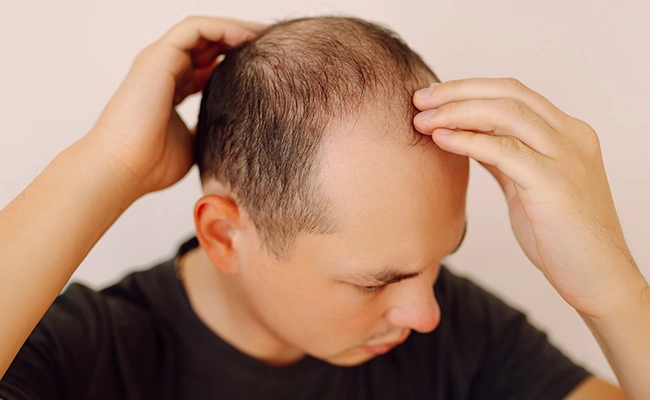
What is androgenetic alopecia
Androgenetic alopecia (also known as “hereditary” hair loss) is the most common form of alopecia. It has a progressive course and a clearly defined genetic background.
It is caused by increased sensitivity of hair follicles to dihydrotestosterone (DHT), a derivative of testosterone, which gradually leads to the shrinkage of hair follicles and a reduction in the hair growth phase.
Hair loss follows characteristic patterns in men and women, and its onset can occur as early as adolescence.
The severity and progression vary depending on genetic predisposition, androgen levels, and other aggravating factors.
If started early, appropriate treatments allow management of alopecia to the extent possible in each individual case.
Causes
Androgenetic alopecia is the common type of hair loss caused mainly by hereditary and hormonal factors.
It is associated with the action of DHT, a derivative of testosterone, which affects the hair follicles.
The main causes of androgenetic alopecia include:
Genetic predisposition
Hereditary sensitivity in hair loss, that may be inherited by both parents
Hormonal changes
Changes in androgen levels (testosterone, DHT), mainly in men but also in women, especially after menopause or due to polycystic ovary syndrome.
Medicine use
Certain substances, such as androgens, steroids, anabolic agents, or hormonal treatments, may affect DHT balance and accelerate the progression of alopecia in predisposed individuals
Stress and psychological factors
They cannot cause alopecia, but they can accelerate hair loss or additional diffuse hair shedding
Nutritional shortages
A deficiency of iron, vitamins (such as D, B12), or proteins can affect overall hair health and exacerbate existing thinning.
Pathology
Endocrine or metabolic disorders (e.g., thyroid) can influence the rate of hair loss progression. The presence of these causes does not necessarily lead to immediate hair loss, but it significantly increases the likelihood of gradual thinning over time
Genetic predisposition
Hereditary sensitivity in hair loss, that may be inherited by both parents
Hormonal changes
Changes in androgen levels (testosterone, DHT), mainly in men but also in women, especially after menopause or due to polycystic ovary syndrome.
Medicine use
Certain substances, such as androgens, steroids, anabolic agents, or hormonal treatments, may affect DHT balance and accelerate the progression of alopecia in predisposed individuals
Stress and psychological factors
They cannot cause alopecia, but they can accelerate hair loss or additional diffuse hair shedding
Nutritional shortages
A deficiency of iron, vitamins (such as D, B12), or proteins can affect overall hair health and exacerbate existing thinning.
Pathology
Endocrine or metabolic disorders (e.g., thyroid) can influence the rate of hair loss progression. The presence of these causes does not necessarily lead to immediate hair loss, but it significantly increases the likelihood of gradual thinning over time
Androgenetic alopecia symptoms
Androgenetic alopecia appears as gradual hair loss, following characteristic patterns depending on sex and progressing progressively over time.
Hair loss is not accompanied by other symptoms or skin lesions, as it is a non-scarring form of hair loss.
Androgenetic alopecia progresses differently in men and women:
- In men, recession of the frontal hairline and thinning at the vertex is observed.
- In women, hair loss is diffuse on the top of the scalp without complete recession of the hairline. In androgenetic alopecia, hair thinning occurs in the front, upper, and top regions of the scalp.
In contrast, the sides and back of the scalp retain normal hair growth, as they are not affected by this form of hair loss.
Androgenetic alopecia symptoms
Androgenetic alopecia appears as gradual hair loss, following characteristic patterns depending on sex and progressing progressively over time.
Hair loss is not accompanied by other symptoms or skin lesions, as it is a non-scarring form of hair loss.
Androgenetic alopecia progresses differently in men and women:
- In men, recession of the frontal hairline and thinning at the vertex is observed.
- In women, hair loss is diffuse on the top of the scalp without complete recession of the hairline. In androgenetic alopecia, hair thinning occurs in the front, upper, and top regions of the scalp.
In contrast, the sides and back of the scalp retain normal hair growth, as they are not affected by this form of hair loss.
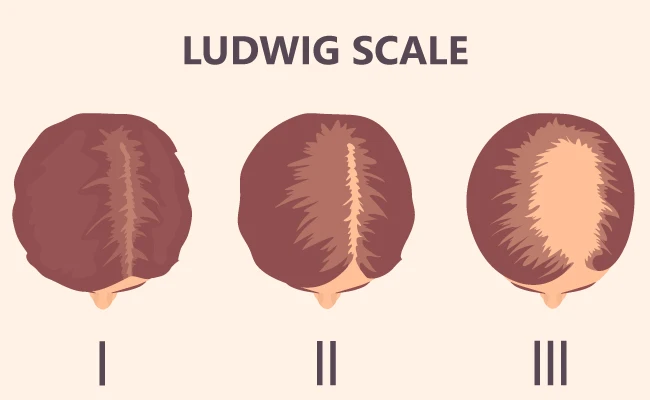
The illustration highlights the characteristic hair loss patterns that assist in diagnosis and the selection of a treatment approach depending on sex.
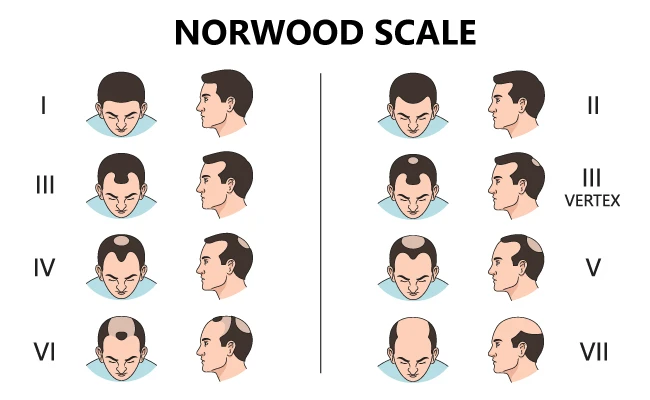
The progression of androgenetic alopecia is classified based on internationally recognized scales (Male Pattern Hair Loss / Female Pattern Baldness):
Norwood-Hamilton scale (for men):
Describes hair loss progression in seven stages, from the initial stage to extensive thinning.
Ludwig scale (for women):
Assesses the severity of diffuse thinning in three stages on the top of the scalp.
Early recognition of symptoms allows timely initiation of appropriate treatment, increasing the chances of stabilizing or even improving the condition.
The illustration highlights the characteristic hair loss patterns that assist in diagnosis and the selection of a treatment approach depending on sex.
The progression of androgenetic alopecia is classified based on internationally recognized scales (Male Pattern Hair Loss / Female Pattern Baldness):
Norwood-Hamilton scale (for men):
Describes hair loss progression in seven stages, from the initial stage to extensive thinning.
Ludwig scale (for women):
Assesses the severity of diffuse thinning in three stages on the top of the scalp.
Early recognition of symptoms allows timely initiation of appropriate treatment, increasing the chances of stabilizing or even improving the condition.
Hair loss mechanism
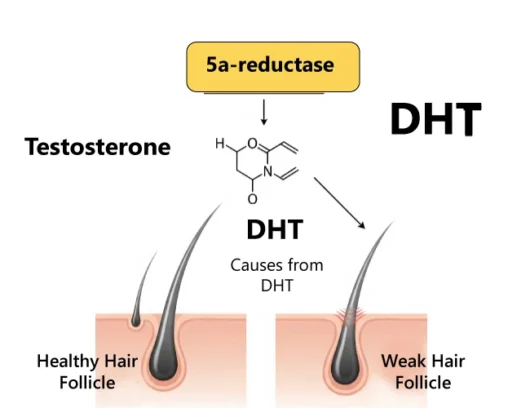
In androgenetic alopecia, hair loss is caused by the action of androgen hormones, mainly dihydrotestosterone (DHT).
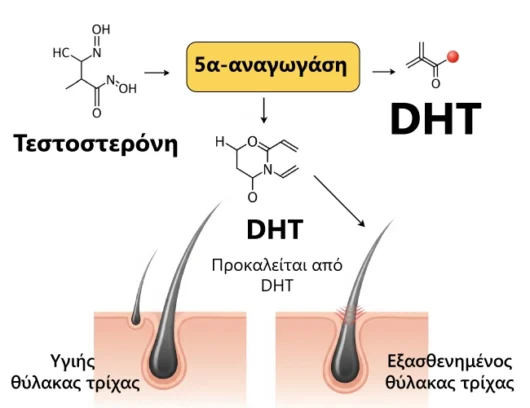
Testosterone, which normally circulates in the blood, is converted into DHT by the action of the enzyme 5-alpha reductase.
DHT binds to the receptors of hair follicles in genetically predisposed individuals and gradually causes their shrinkage (miniaturization).
The result is that the hairs become thinner, shorter, and weaker with each new growth cycle, until they eventually resemble fine down, and the scalp loses its density.
This process mainly affects the front, upper, and top regions of the scalp, while the sides and back usually remain unaffected.
Hair loss mechanism
In androgenetic alopecia, hair loss is caused by the action of androgen hormones, mainly dihydrotestosterone (DHT).
Testosterone, which normally circulates in the blood, is converted into DHT by the action of the enzyme 5-alpha reductase.
DHT binds to the receptors of hair follicles in genetically predisposed individuals and gradually causes their shrinkage (miniaturization).
The result is that the hairs become thinner, shorter, and weaker with each new growth cycle, until they eventually resemble fine down, and the scalp loses its density.
This process mainly affects the front, upper, and top regions of the scalp, while the sides and back usually remain unaffected.
Androgenetic alopecia in women
Androgenetic alopecia does not affect only men; it also affects women, although in a different way.
In women, hair loss usually appears as diffuse thinning on the top of the scalp, without recession of the frontal hairline or defined bald areas, as seen in men.
During reproductive age, estrogens and aromatase — an enzyme that converts androgens into estrogens — provide a protective effect, limiting the impact of DHT on hair follicles. For this reason, alopecia is milder.
After menopause, the decrease in estrogen levels and aromatase activity can accelerate hair loss.
Diagnosis of androgenetic alopecia
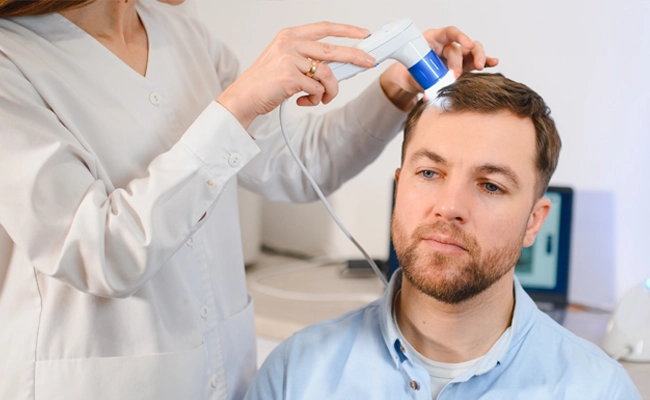
The diagnosis of androgenetic alopecia is primarily based on the clinical presentation and the patient’s history. The specialist evaluates the pattern and extent of hair loss.
Diagnostic scales such as the Norwood-Hamilton for men and the Ludwig for women are used for assessment. Additionally, tools like trichoscopy, the pull test, and the hair root analysis (trichogram) are applied, while in some cases blood tests are requested to rule out other causes.
Accurate diagnosis is crucial, as it guides the selection of the appropriate treatment and differentiates it from other forms of alopecia.
Diagnosis of androgenetic alopecia
The diagnosis of androgenetic alopecia is primarily based on the clinical presentation and the patient’s history. The specialist evaluates the pattern and extent of hair loss.
Diagnostic scales such as the Norwood-Hamilton for men and the Ludwig for women are used for assessment. Additionally, tools like trichoscopy, the pull test, and the hair root analysis (trichogram) are applied, while in some cases blood tests are requested to rule out other causes.
Accurate diagnosis is crucial, as it guides the selection of the appropriate treatment and differentiates it from other forms of alopecia.
Therapeutic options for androgenetic alopecia
Treatment of androgenetic alopecia aims to slow hair loss and strengthen hair growth, with options ranging from non-invasive to surgical.
Non-invasive treatments
Management of androgenetic alopecia relies on therapies that aim to slow hair loss and strengthen hair follicles.
Their goal is to stabilize hair loss, prolong the hair growth phase, and improve hair density and quality.
The main options include minoxidil, which stimulates blood flow and strengthens hair follicles; finasteride, which inhibits DHT activity, reducing further hair loss; and autologous hair mesotherapy, which uses the patient’s own growth factors to rejuvenate the follicles.
Invasive options
Hair transplantation offers a definitive solution for androgenetic alopecia, restoring natural hair growth in areas with thinning or gaps.
It is often combined with other treatments (minoxidil, autologous hair mesotherapy) to maintain existing hair and stabilize hair loss.
The choice of treatment is individualized based on the stage of thinning, sex, and patient expectations, while consistency and long-term follow-up are required.