


Alopecia Areata – Patchy Hair Loss: Causes, Symptoms, Treatment
Alopecia areata, also known as patchy hair loss, is an autoimmune form of alopecia that causes sudden hair loss, usually in round or oval patches on the scalp or other parts of the body.
It can appear at any age, even very early in life, and is often associated with genetic predisposition or other autoimmune conditions.
Although it does not affect physical health, its psychological impact can be significant. Today, there are treatment options that help manage the condition and potentially restore hair growth.
The course of the disease is unpredictable, as in some cases hair regrowth occurs spontaneously, while in others relapses are frequent.
Therefore, early diagnosis and guidance from a specialist play a crucial role in managing alopecia areata.
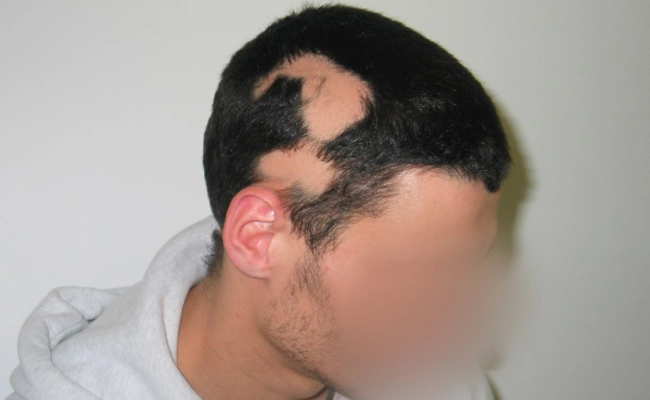
Alopecia areata, also known as patchy hair loss, is an autoimmune form of alopecia that causes sudden hair loss, usually in round or oval patches on the scalp or other parts of the body.
It can appear at any age, even very early in life, and is often associated with genetic predisposition or other autoimmune conditions.
Although it does not affect physical health, its psychological impact can be significant. Today, there are treatment options that help manage the condition and potentially restore hair growth.
The course of the disease is unpredictable, as in some cases hair regrowth occurs spontaneously, while in others relapses are frequent.
Therefore, early diagnosis and guidance from a specialist play a crucial role in managing alopecia areata.
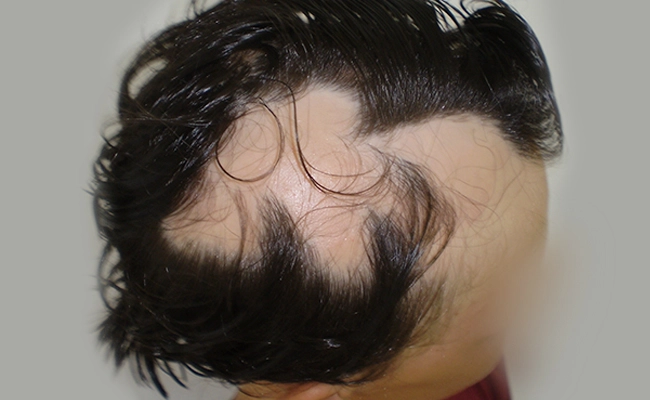
Alopecia areata, often referred to as “patchy hair loss,” is an autoimmune form of hair loss in which the immune system mistakenly attacks the hair follicles. As a result, hair growth is interrupted.
Alopecia areata appears suddenly, in small, round or oval patches on the scalp or other areas of the body, such as the eyebrows or beard.
“Patchy hair loss on the scalp” is the most typical presentation, and its occurrence in children is not uncommon.
The course of the condition is unpredictable: in some cases it remains limited, while in others it progresses to more extensive thinning.
According to research, the lifetime prevalence of alopecia areata is estimated at around 2%. Additionally, it affects up to 3% of patients who seek specialist care for dermatological concerns.
What is alopecia areata
Alopecia areata, often referred to as “patchy hair loss,” is an autoimmune form of hair loss in which the immune system mistakenly attacks the hair follicles. As a result, hair growth is interrupted.
Alopecia areata appears suddenly, in small, round or oval patches on the scalp or other areas of the body, such as the eyebrows or beard.
“Patchy hair loss on the scalp” is the most typical presentation, and its occurrence in children is not uncommon.
According to research, the lifetime prevalence of alopecia areata is estimated at around 2%. Additionally, it affects up to 3% of patients who seek specialist care for dermatological concerns.
Types of alopecia areata
Alopecia areata does not manifest the same way in everyone. The pattern of hair loss can vary significantly, both in the size of the affected areas and in the degree of hair loss. For this reason, the condition is classified into different types and forms, depending on its characteristics.
Based on how extensive the hair loss is, the condition may be considered mild—when limited to a few small patches—or extensive, when it covers a large portion or even the entire scalp.
Depending on the distribution of the hair loss, alopecia areata is classified into the following forms:
- Localized (patch-type): One or more round, hairless patches, mainly on the scalp.
- Circumscribed: A single isolated patch, with no tendency to expand.
- Diffuse: Thinning that resembles androgenetic alopecia.
- Ophiasis: Peripheral hair loss along the neckline and behind the ears.
- Alopecia areata totalis: Complete loss of hair on the scalp, eyebrows, and eyelashes.
- Alopecia areata universalis: Complete loss of all body hair.
Identifying the type and form is crucial for prognosis and selecting the appropriate therapeutic approach.
Causes of alopecia areata
Alopecia areata is an autoimmune disorder in which the immune system mistakenly attacks the hair follicles. The exact causes are not fully understood; however, it appears to be associated with:
Causes of alopecia areata
Alopecia areata is an autoimmune disorder in which the immune system mistakenly attacks the hair follicles. The exact causes are not fully understood; however, it appears to be associated with:
Genetic predisposition
Many patients have a family history of alopecia areata (patchy hair loss) or other autoimmune conditions. Genetic predisposition appears to increase the likelihood of developing the disorder.
Psychological factors (stress)
Severe psychological stress or a traumatic event can act as a trigger for alopecia areata. Although it is not the main cause, it is often associated with the onset or recurrence of the condition.
Other autoimmune diseases
Alopecia areata often coexists with conditions such as Hashimoto’s thyroiditis, vitiligo, or type 1 diabetes. This suggests shared immunological dysfunctions.
Environmental or viral factors
Certain viruses or environmental triggers are believed to potentially provoke immune system dysfunction. Although the exact mechanism is unclear, they are being investigated as possible contributing factors in the development of alopecia areata.
Genetic predisposition
Many patients have a family history of alopecia areata (patchy hair loss) or other autoimmune conditions. Genetic predisposition appears to increase the likelihood of developing the disorder.
Psychological factors (stress)
Severe psychological stress or a traumatic event can act as a trigger for alopecia areata. Although it is not the main cause, it is often associated with the onset or recurrence of the condition.
Other autoimmune diseases
Alopecia areata often coexists with conditions such as Hashimoto’s thyroiditis, vitiligo, or type 1 diabetes. This suggests shared immunological dysfunctions.
Environmental or viral factors
Certain viruses or environmental triggers are believed to potentially provoke immune system dysfunction. Although the exact mechanism is unclear, they are being investigated as possible contributing factors in the development of alopecia areata.
What are the symptoms of alopecia areata
Regarding the symptoms of alopecia areata, the most common ones include:
- The appearance of one or more round patches without hair (mainly on the scalp).
- A smooth surface at the site of hair loss, without inflammation or flaking.
- A possible sensation of irritation, burning, or itching before the hair falls out.Nail changes (e.g., fine ridges or white spots) in some cases
- .In more extensive forms: loss of eyebrows, eyelashes, or even all body hair.
Diagnosis of alopecia areata
The diagnosis of alopecia areata is primarily based on clinical evaluation. The characteristic round pattern of hair loss is often sufficient to raise diagnostic suspicion.
Dermatological evaluation
A detailed examination of the scalp reveals the typical presentation of the condition, without signs of inflammation or flaking. Often, isolated “exclamation mark hairs” can be seen in the affected areas.
Dermatoscopy
The use of a dermatoscope helps provide a detailed view of the area and confirms the clinical diagnosis, highlighting typical findings such as broken hairs or inactive hair follicles.
Laboratory tests
Depending on age, medical history, and the extent of the condition, blood tests may be requested to rule out associated autoimmune diseases (such as thyroid disorders, iron deficiency, or vitiligo).
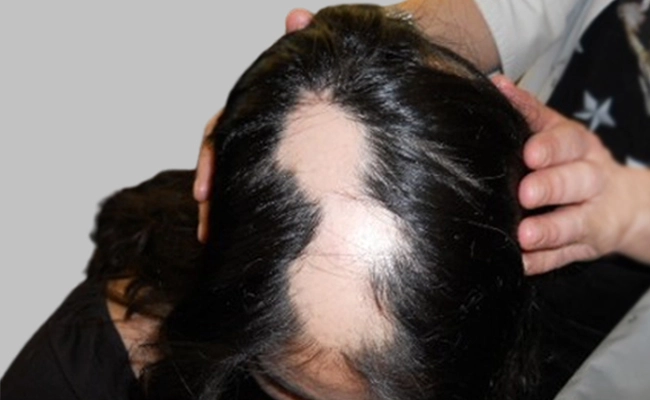
The diagnosis of alopecia areata is primarily based on clinical evaluation. The characteristic round pattern of hair loss is often sufficient to raise diagnostic suspicion.
The diagnosis of alopecia areata is primarily based on clinical evaluation. The characteristic round pattern of hair loss is often sufficient to raise diagnostic suspicion.
Dermatological evaluation
A detailed examination of the scalp reveals the typical presentation of the condition, without signs of inflammation or flaking. Often, isolated “exclamation mark hairs” can be seen in the affected areas.
Dermatoscopy
The use of a dermatoscope helps provide a detailed view of the area and confirms the clinical diagnosis, highlighting typical findings such as broken hairs or inactive hair follicles.
Laboratory tests
Depending on age, medical history, and the extent of the condition, blood tests may be requested to rule out associated autoimmune diseases (such as thyroid disorders, iron deficiency, or vitiligo).
How is alopecia areata treated?
Alopecia areata is managed with various therapeutic approaches depending on the patient’s age, the extent of hair loss, and the duration of the condition.
In many cases, hair regrowth occurs within two years without the need for intervention.
However, treatment can accelerate hair regrowth and help reduce the immune response that causes the hair loss. The most effective treatment options include:
Corticosteroids
Corticosteroids are medications that suppress the immune system’s inflammatory response. They can be administered in the following ways:
- Injectable form, directly into the patches of hair loss (usually in adults). The treatment is repeated every 3–6 weeks, and hair regrowth typically begins within 4 weeks.
- Topical form, as creams, lotions, or ointments applied to the bald patches. These are less effective than injections but are often preferred for children due to their milder safety profile.
- Oral form, as pills, used only in severe or extensive cases. Because of potential serious side effects, dermatologists use this option with great caution.
Immunomodulatory medications
In particularly aggressive or extensive forms of alopecia areata, systemic immunomodulatory therapy may be used.
Its purpose is to regulate the excessive immune response that leads to the destruction of hair follicles. These treatments are administered under strict medical supervision due to their increased risk of side effects.
Minoxidil
Minoxidil is applied topically twice daily to the scalp, eyebrows, or beard. It may enhance hair regrowth within approximately 2 months. It is used in both adults and children, often in combination with other treatments for better results.
Autologous Hair Mesotherapy
Autologous hair mesotherapy is a supportive option for the management of alopecia areata (patchy hair loss).
It is used with the aim of stimulating local microcirculation, improving the function of the hair follicles, and enhancing the natural process of hair regrowth. Autologous mesotherapy can be combined with other treatments, such as corticosteroids or minoxidil, further boosting the overall effectiveness of the therapeutic plan.
Its application has shown positive results in cases of mild to moderate alopecia areata, in both adults and children. It is a safe and well-tolerated option that helps strengthen hair growth and promotes faster restoration of the affected areas.
Corticosteroids
Corticosteroids are medications that suppress the immune system’s inflammatory response. They can be administered in the following ways:
- Injectable form, directly into the patches of hair loss (usually in adults). The treatment is repeated every 3–6 weeks, and hair regrowth typically begins within 4 weeks.
- Topical form, as creams, lotions, or ointments applied to the bald patches. These are less effective than injections but are often preferred for children due to their milder safety profile.
- Oral form, as pills, used only in severe or extensive cases. Because of potential serious side effects, dermatologists use this option with great caution.
Immunomodulatory medications
In particularly aggressive or extensive forms of alopecia areata, systemic immunomodulatory therapy may be used.
Its purpose is to regulate the excessive immune response that leads to the destruction of hair follicles. These treatments are administered under strict medical supervision due to their increased risk of side effects.
Minoxidil
Minoxidil is applied topically twice daily to the scalp, eyebrows, or beard. It may enhance hair regrowth within approximately 2 months. It is used in both adults and children, often in combination with other treatments for better results.
Autologous Hair Mesotherapy
Autologous hair mesotherapy is a supportive option for the management of alopecia areata (patchy hair loss).
It is used with the aim of stimulating local microcirculation, improving the function of the hair follicles, and enhancing the natural process of hair regrowth. Autologous mesotherapy can be combined with other treatments, such as corticosteroids or minoxidil, further boosting the overall effectiveness of the therapeutic plan.
Its application has shown positive results in cases of mild to moderate alopecia areata, in both adults and children. It is a safe and well-tolerated option that helps strengthen hair growth and promotes faster restoration of the affected areas.
FAQs
Contact Form